

BLOUGE BOX X3
BLOUGE BOX X3
Couldn't load pickup availability
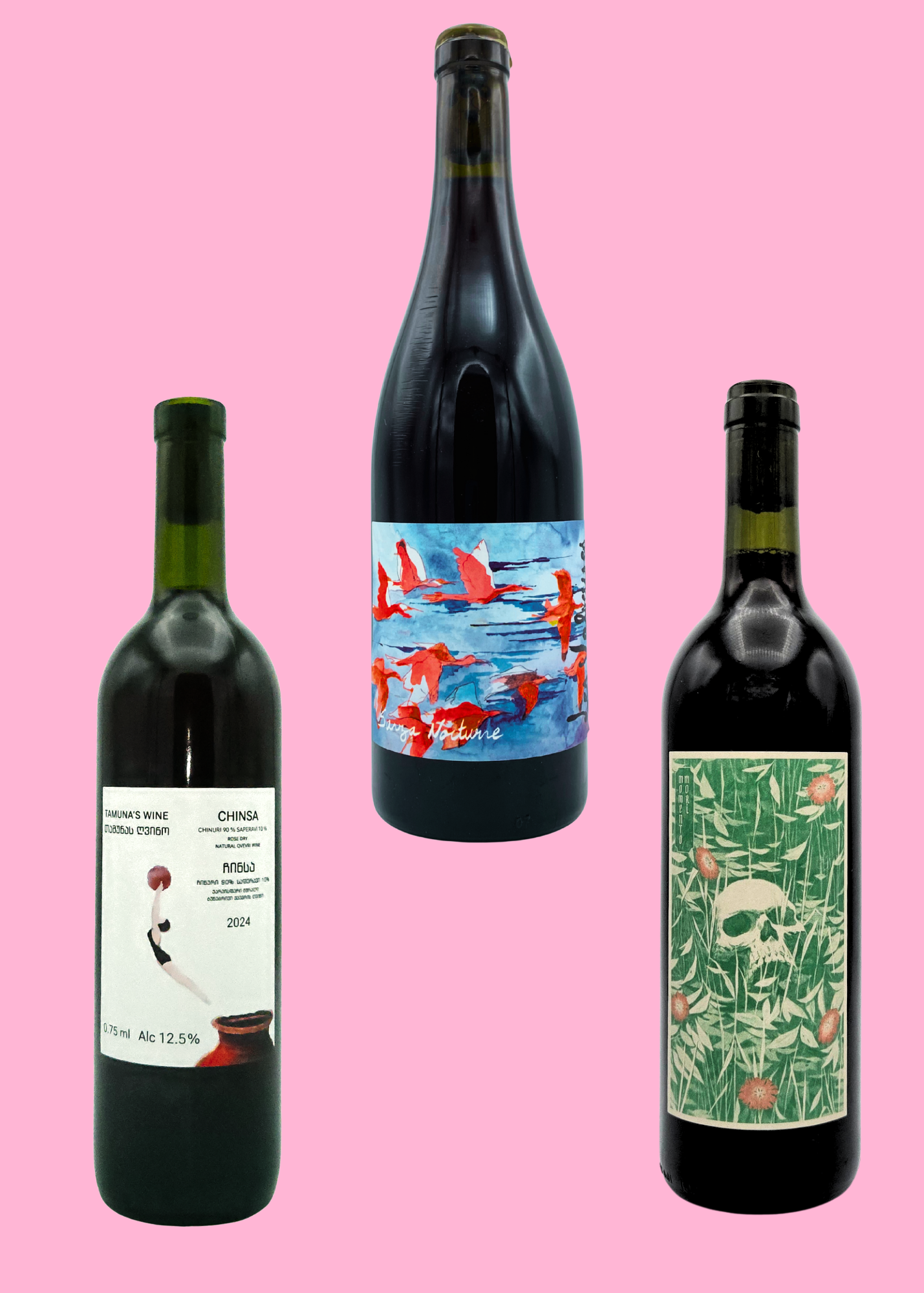
Our selection of everyday juicy blouges for you to discover or enjoy! Keep them all chilled for consumption and enjoy~
In order of tannin intensity
Tamuna ChinSa 2024 - Native varietal white-red blend from Kakheti in Georgia. Think berry cordial and summer faire pairings
Les Valzeuses Sanza Nocturne 2023- A Grenache blend (Noir & Gris), offering a syrupy texture. Ripe blackcurrant and dark plum on the fruit with floral hints on the end.
Momento Mori Rack & Ruin 2021 - An experimental cuvée that Dane made during COVID times. A blend of 2 Italian varietals. All the tannin is from the Ribolla, and the ruby-red hue is from the Nerello Mascalese. Perfect with Thai and Vietnamese.
Share
Organic, Biodynamic and Natural wine. What’s the difference?
To understand this concept and its various ramifications, it is necessary to keep something clear in mind: before the 20th century and the spreading of affordable synthetic fertilisers, all farming was organic. When the shift to the use of synthetics and pesticides happened, it became necessary to diversify traditional organic farming from the new modern farming.
ORGANIC WINE
Simply put, organic farming forbids the use of synthetic fertilisers, synthetic pesticides, herbicides, or genetically modified organisms. The basic requirements are generally specific and engage the farmers not to use any chemical fertilisers and other synthetic products in the vineyard. It does not prevent the vintner from using the conventional winemaking process after harvesting.
BIODYNAMIC WINE
Let’s take organic farming one step further: Biodynamic. The creator of this agricultural system is the Austrian philosopher Rudolf Steiner, who developed the principles of biodynamics in a series of lectures given in 1924 in Germany. Here lies the foundation of true organic wines, with a strict limit in the use of additives, stringent requirements and at the end obtaining a biodynamic certification.
NATURAL WINE
The previous definitions are usually, and rightfully, associated with it, because most natural wine is also organic and/or biodynamic. But not vice versa!
Natural wine is wine in its purest form, simply described as nothing added, nothing taken away, just grapes fermented. No manipulation whatsoever, minimal intervention both in the vineyards and in the winery. Healthy grapes, natural yeast and natural fermentation, with no filtration nor fining. Sounds easy, right? However, making natural wine is unforgiving and it requires a bigger amount of work than conventional wine. To this day, natural wine has no certification yet.